Two tracks of writing. Voices from the contributor community on language, remote work, and life. Deep dives for developers building with speech and voice AI.

A well-defined speech data project brief ensures your model meets real user needs. Here’s how to create one that covers all essential aspects.
 Innocent Ociti·August 25, 2026
A speech dataset quote for a low-resource language often runs higher than for a mainstream one, and it isn't a markup. Here are the five real drivers behind it: language rarity, speaker recruitment, recording conditions, annotation depth, and turnaround.
 Emil Thorsson·July 30, 2026
Medical audio annotation runs on different assumptions than general call center work. Why generalist annotator pools fail on clinical audio, what clearance and PII handling actually look like as a process, and when you need domain experts instead of more throughput.
Emil Thorsson·July 30, 2026
Scripted vs spontaneous speech data isn't a style preference, it's a decision your target audio should make for you. Here's the actual test, the measurable gap between the two, and what training on the wrong register breaks downstream.
 Gustav Aggeboe·July 30, 2026
Diarization looks solid in the demo, then breaks on real audio: overlapping speech, similar voices, short turns, channel changes, crosstalk. Here's what each failure mode actually does downstream, and how to catch it early.
Gustav Aggeboe·July 30, 2026
Teams ask how many hours of call history they need before speech analytics is reliable. The honest answer: hours are the wrong axis. Here's what actually determines sufficiency, and how to measure it yourself.
Gustav Aggeboe·July 30, 2026
LibriSpeech, LJSpeech, and Common Voice are all free for commercial use, but the three licenses don't ask the same thing of you. A corpus-by-corpus breakdown of what each one actually obliges.
Emil Thorsson·July 30, 2026
A speech AI model's performance often hinges on the quality of its training data. Understanding user demographics, recording environments, and device variations is crucial for building effective voice products.
Innocent Ociti·July 9, 2026
Most make-money-with-AI advice is hype. Here is a skeptical look at what actually pays, what does not, and the low-barrier option the guides skip.
 Andreas Kromann·July 5, 2026
You can start remote transcription jobs with no experience. Here is what the work really pays, the setup that raises your rate, and where the field is heading.
Andreas Kromann·July 5, 2026
You can get paid to record your voice from home, and it is not voice-over acting. Here is what voice recording jobs for AI involve and why accents pay.
Andreas Kromann·July 5, 2026
AI training jobs are real, but scams surround them. Here is how legitimate platforms work, the red flags to walk away from, and how the big names compare.
Emil Thorsson·July 5, 2026
Data annotation jobs from home are real, entry-level, and paid per task. Here is what the work is, what it pays, and how to start without experience.
Emil Thorsson·July 5, 2026
A working engineer's tour of speaker diarization: segmentation, embeddings, EEND, overlap, and how Diarization Error Rate behaves once you push it through a real pipeline.
Gustav Aggeboe·June 21, 2026
You found the lead. Now you have to convert it. Here's the proposal structure I use, with the data on what actually closes, plus a fill-in template you can reuse.
Andreas Kromann·June 21, 2026
A hands-on look at the augmentation techniques that make speech models more robust, which ones risk corrupting your transcripts, and a default recipe that holds up at scale.
Gustav Aggeboe·June 12, 2026
Most freelancers price by gut feel and leave money on the table. Here's a cost-plus method to set a baseline rate, research your market, and raise it without losing clients.
Andreas Kromann·June 12, 2026
Finding clients is the hardest part of freelancing. Here are nine concrete ways to land work in 2025, from LinkedIn to referrals to microtask platforms, with the numbers behind each one.
Andreas Kromann·June 10, 2026
Word error rate is the default ASR accuracy metric, but the number means nothing without context. How WER is calculated, what counts as good, and what really moves it.
Gustav Aggeboe·June 9, 2026
Co-founding Spirelight was a journey of testing partnerships and building a strong team. Discover how we aim to lead in AI training data across Europe.
Innocent Ociti·May 5, 2026
Discover the best options for obtaining Danish voice training data for your AI models, from open-source datasets to custom collections. Learn how to create a targeted dataset that meets your specific needs.
Andreas Kromann·May 4, 2026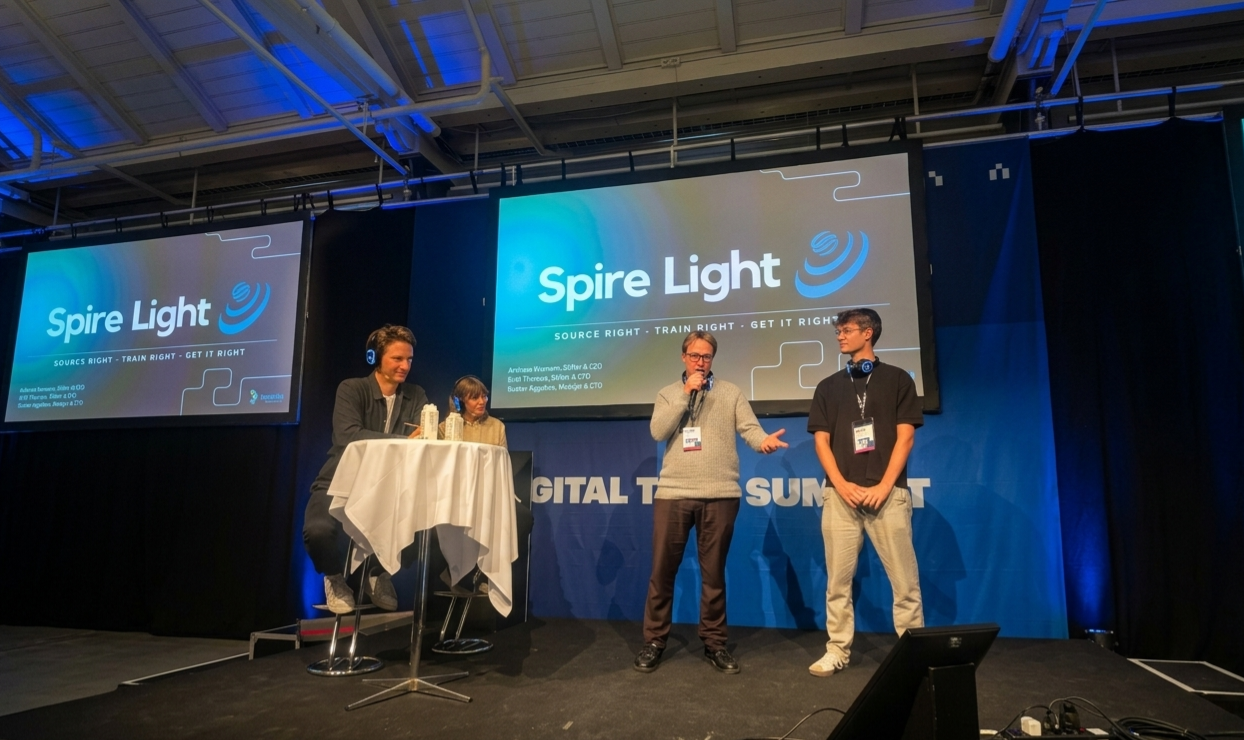
In 2019, Andreas Kromann found himself in Southeast Asia, discovering the speech training data industry. This post explores the evolution of Spirelight and the key players who shaped its journey.
Innocent Ociti·April 28, 2026